

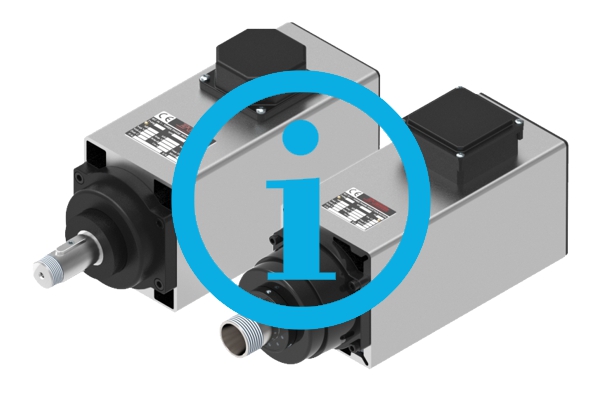
Differences Between an HF Motor and an Electrospindle
The fundamental differences stem from the type of load that can occur on the shaft during operation. A motor has a bearing system that can accept consistent radial loads and very small axial loads. An electrospindle can accept loads parallel to the axis (axial load) and simultaneously perpendicular to the axis (radial load). Typical bearing arrangements for a motor are SB, while for an electrospindle they are DBS, DB, DBL, 2DB.
An electrospindle can work when drilling deep holes in solid wood (axial load – full axial load), milling with the side edge of the cutter (pure radial load), and performing 3D contour milling (mixed load).
Single Key and Double (Symmetrical) Key
When ordering a high-speed motor, attention must be paid to the correct balancing of the combined rotor + tool system. If a single key (Half key) is used, problems with correctly balancing the mechanical system can occur, which may lead to vibrations that drastically shorten the motor’s lifespan. Vibrations can irreversibly damage the motor within just a few hours. Using a double-sided key (Full key) ensures easier balancing of the system due to the maintained symmetry of the rotating mass.
Electrospindle Selection – Important Tips
When selecting electrospindles, we are not guided solely by power and maximum RPM, but by the power at given RPMs, which directly translates to torque. A larger shaft diameter along with larger bearings guarantees increased mechanical strength of the spindle against radial and axial forces. However, on the other hand, larger bearings wear out faster at high RPMs, and therefore, one should not overdo it but select the spindle optimally.
For work with large-diameter cutters, maximum RPMs are not used, and obtaining the highest possible torque is required. Small-diameter cutters require high RPMs and low torque. It is therefore advisable for the nominal operating frequency to be lower than the maximum.