

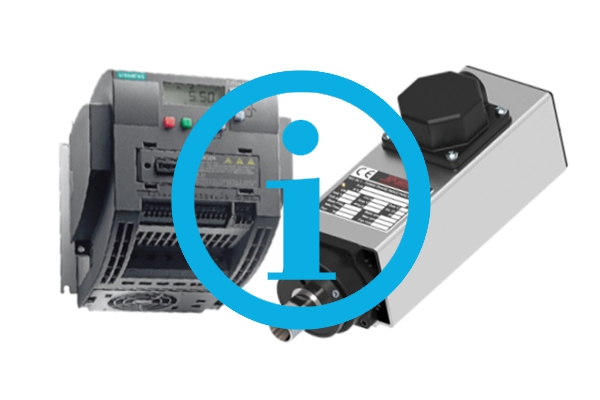
Inverter Parameters
We select inverter parameters based on several factors: motor power, operating voltage, rated current, operating frequency, number of acceleration and braking cycles within a given time period, required control type (binary, Modbus, USS, analog, mixed), inverter operating mode (vector or scalar), and interference emission.
In the case of Siemens Sinamics V20 inverters, which have an overload capacity of 150% for one minute, the inverter power is selected to be >= the motor power. However, a more critical selection criterion is the inverter’s rated current, which must be greater than the motor’s current. For this reason, it sometimes happens that for a 5.6kW motor, a 5.5kW inverter with an adequate current reserve is more than sufficient.
Regarding the inverter’s output voltage frequency, it directly impacts the rotational speed of a three-phase motor. For standard motors designed to operate directly from a 50Hz mains supply, the rotational speed is approximately 50 revolutions per second (i.e., 3000 RPM). If the motor requires a voltage frequency of 400Hz, we must ensure the inverter can achieve this frequency. For example, this would be the case when an inverter is paired with a 24000 RPM, 400Hz three-phase electrospindle. It is always crucial to correctly program the V/f (Voltage/Frequency) characteristic.
Setting Selection
Every three-phase motor heats up during operation due to iron losses and resistive losses in the conductors of the stator and rotor cage. This heating primarily depends on the current flowing through the windings during motor acceleration and operation. When considering motor braking, the associated thermal phenomena are often overlooked. Therefore, an appropriate motor braking method must be selected based on the specific application. If the motor can coast to a stop over an extended period, the simplest braking method can be used by setting only the deceleration ramp (e.g., to 10 seconds) to prevent overcharging the inverter’s capacitors. However, if rapid stopping is required, a large amount of rotational energy must be removed from the motor quickly. For Siemens Sinamics V20 inverters, two options are available: compound braking or regenerative (dynamic) braking, where energy is transferred to an external high-power resistor.
Compound braking operates in a mixed mode, alternately decelerating the rotating magnetic field by a certain amount and then injecting the recovered energy from the motor back into its windings as direct current (DC). This method achieves moderate braking times but causes significant motor heating. Therefore, it is not recommended for applications involving frequent motor starting and braking.
Regenerative (dynamic) braking, utilizing a braking unit (either built-in or external), ensures the most effective braking with minimal heat generation in the motor. All the energy is returned to the inverter and dissipated in the braking resistor. When multiple inverters are connected via a common DC bus, the energy from one braking motor can be utilized by other inverters.
Built-in braking units are present in inverters with a power rating of >= 7.5kW.
Control
The inverter can be controlled in various ways: via 24V DC binary signals, RS485 serial communication using Modbus or USS protocols, analog signals (for speed control), or a combination of these methods. Siemens Sinamics V20 inverters offer virtually limitless configuration possibilities in this respect.
RFI Emission (Radio Frequency Interference)
Using inverters equipped with filters prevents the emission of RFI back into the power supply network. The absence of such filters can disrupt the operation of nearby radio equipment and devices using USB communication. Shielded cables must be used between the inverter and the motor. For applications with moving parts, flexible cables designed for continuous duty in cable carriers (e.g., energy chains) with an appropriate bending radius are required. Note! Standard control cables, while appearing flexible, are not suitable for continuous motion applications. Use chain-flex type cables.
Scalar or Vector Inverter
When choosing between vector and scalar control methods, electrospindle manufacturer Teknomotor recommends using scalar inverters due to lower thermal losses in the motor. Vector control can lead to excessive motor heating, particularly at lower rotational speeds..